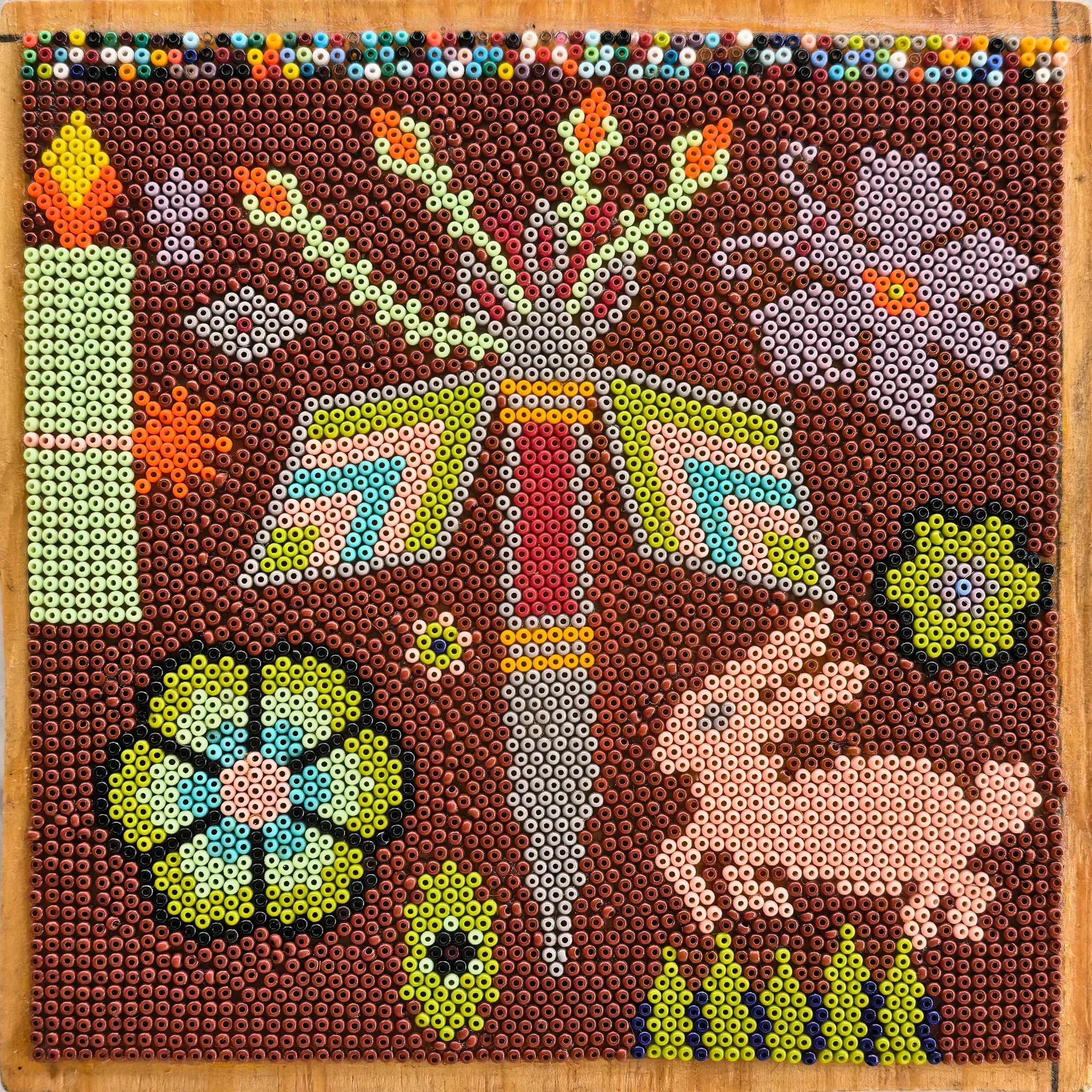
La pluma sagrada, solo para hacer limpia los chamanes
Santos Motoapohua de la Torre (1942–)
Beads, beeswax and plywood · 15 × 15 cm
The back is inscribed and signed: "La pluma sagrada solo para aser limpia los shamanes hecho por Santos M. de la Torre de Santiago y familia" (The sacred feather, only for the shamans to perform cleansings, made by Santos M. de la Torre de Santiago and family).
A feathered staff fills the center. On its site Universos huicholes, INAH, Mexico's Instituto Nacional de Antropología e Historia, describes the shaman's ceremonial staff, the muwieri, as "una vara con plumas" (a staff with feathers), and writes that "Los muwierite también son utilizados por los mara’akate en curaciones y limpias" (the shamans, mara’akate, also use them in healings and cleansings). In Birth of the Kieri (1973), a yarn painting by Guadalupe González Ríos explained by Juan Negrín, founding director of the Wixárika Research Center, from a taped conversation with the artist, a shaman uses his muwieri, his plumed arrow, to communicate with the kieri, the tree of wind, "to learn how to heal and how to chant."
Art of the Huichol Indians (1978) photographs two shaman's plumes collected in 1966, each a pointed shaft with hawk feathers bound at its head, and notes that "Shaman’s plumes are used as prayer or votive arrows"; Juan Negrín writes in The Huichol Creation of the World (1975) that on the plumed arrow, the muvieri, "The feathers are believed to bear the words of the gods."
The ethnomusicologist Xilonen Luna Ruiz, in a thesis at the Universidad Nacional Autónoma de México (UNAM), describes how pilgrims on the way to the sacred land of Wirikuta receive "una limpia de pies a cabeza" (a cleansing from head to foot) from the shamans who lead the group, who "con sus plumas pueden quitarles lo profano que envuelve sus cuerpos" (with their feathers can take away the profane that wraps their bodies).
A rabbit is beaded at the lower right. In Negrín's explanation of Tutukila Carrillo Sandoval's 1973 yarn painting The Founding of the World: After the Flood two deer-people lose their antlers near the sacred water sources of Tatéi Matinieri, and one of them, Tatutsí Maxakuaxí, Our Great Grandfather Deer Tail, "eats his antlers, though they are also his muvierixi, the plumed feathers that transmit messages to our ancestors, and for his mistakes he is transformed into the rabbit, tatsiu."
A candle stands at the left, and flowers are beaded around the staff. On INAH's page on the Wixárika Route, candles "representan la luz del Sol y la conexión con las deidades" (represent the light of the Sun and the connection with the deities) and are lit as offerings at the sacred sites. In Birth of the Kieri, Negrín writes that the painting's flowers "represent prayers for life and abundance."