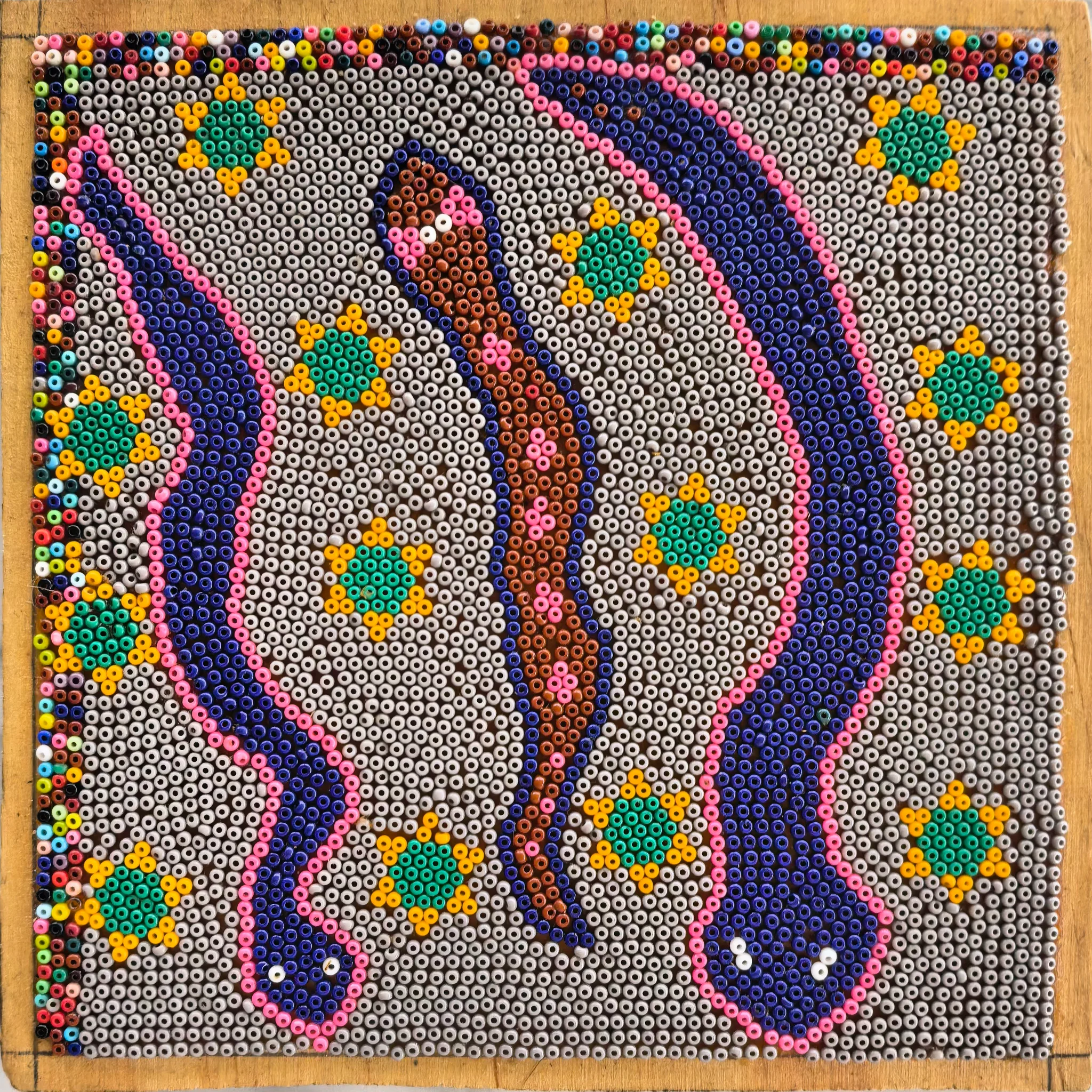
Las mangueras sagradas
Santos Motoapohua de la Torre (1942–)
Beads, beeswax and plywood · 15 × 15 cm
The back is inscribed and signed: "Las mangueras sagradas hecho por Santos M. de la Torre de Santiago y familia" (The sacred hoses, made by Santos M. de la Torre de Santiago and family).
Three serpents are beaded among flowers. In José Benítez Sánchez's account of his yarn painting El nierika de Kauyumarie, explained and translated by Juan Negrín, who with Yvonne Negrín founded the Centro de Investigación Wixárika, "La serpiente (margen derecho) es la lluvia que surge de un árbol" (the serpent, at the right edge, is the rain that springs from a tree), Xaapa, the tree of the rain.
The anthropologist Héctor M. Medina Miranda, of CIESAS-Occidente, writes that Nakawe, "Nuestra Abuela" (Our Grandmother), is identified with "la enorme sierpe que rodea la tierra" (the huge serpent that surrounds the earth), made of the sea and the rivers that flow into it, and that the body of this ancestral deity divides, cyclically, into "las cinco madres de la lluvia" (the five mothers of the rain), who also take the form of the reptile.
In Juan Negrín's interpretation of a 1973 yarn painting by Guadalupe González Ríos, "Flowers represent prayers for life and abundance". Art of the Huichol Indians (Fine Arts Museums of San Francisco, 1978) notes that Wixárika beadwork, embroidery and weaving often show flowers, and since flowers "bloom only during the brief rainy season, they probably represent prayers by association"; "Snakes and the many double water-gourd designs most likely serve a similar purpose."