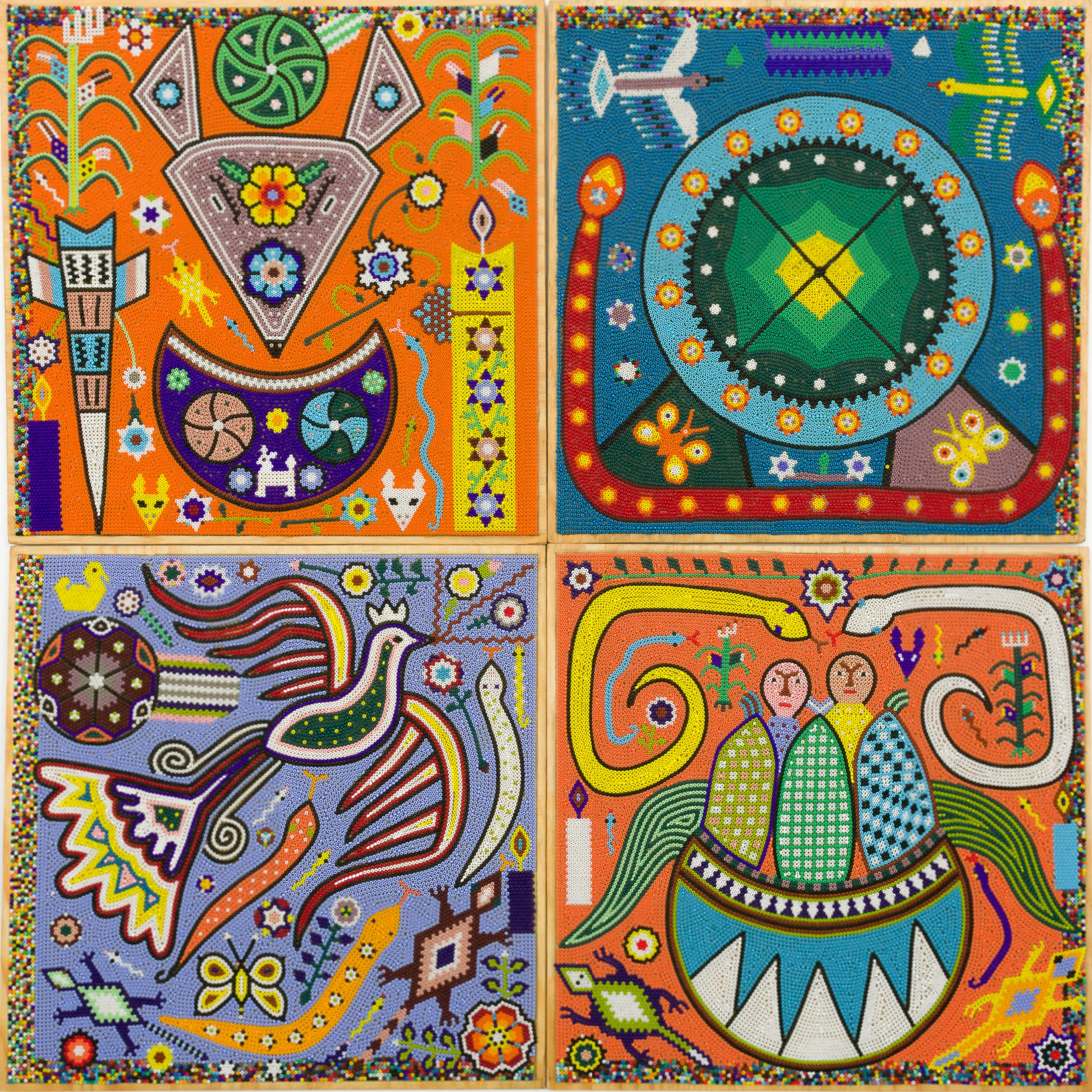
Teteaikutzi
Santos Motoapohua de la Torre (1942–)
2019
Beads, beeswax and plywood · 60 × 60 cm
Three ears of maize stand in a large bowl, with two faces above them. Mexico's Instituto Nacional de Antropología e Historia (INAH) calls maize, iku, “alimento sagrado que representa el cuerpo y la vida del pueblo wixárika” (sacred food that represents the body and life of the Wixárika people). The same text describes the Wixárika gourd bowl, the xukuri, as holding offerings “como maíz, velas, tabaco o plumas” (such as maize, candles, tobacco or feathers), and writes that it “simboliza el vientre de la Madre Tierra” (symbolizes the womb of Mother Earth).
Candles are beaded in three of the four panels. In the same text, candles “representan la luz del Sol y la conexión con las deidades” (represent the light of the Sun and the connection with the deities).
A large disc, quartered by a cross, fills another panel. In Juan Ríos Martínez's 1973 yarn painting Wirikuta I, explained by Juan Negrín, founding director of the Wixárika Research Center, the nierika, the sacred face of Wirikuta, is "the central disk (divided into four colors)."
Lizards are beaded beside the bowl. In Ríos Martínez's Wirikuta II (1975), where Wirikuta is "the sacred land of the ancestors," the lizard, 'imukui, "is the messenger of Wirikuta to pilgrims who seek grace and knowledge there."
October Gallery in London showed Teteaikutzi in Portal II: Inside the Cordillera (November 2019 to February 2020), together with Toto Xaweri: Sonido de Música (Toto Xaweri: Sound of Music) and Untitled.
Shown
- 2019Portal II: Inside the Cordillera, October Gallery, London